Why the roof matters so much
When a bushfire approaches, embers often arrive well before the fire front, carried on hot winds. They drop into gutters full of dry leaves, get blown under loose tiles or into gaps beneath ridge capping, and settle on timber in the roof space. A small fire in a roof cavity can take hold out of sight. That is why preparing the roof is one of the most useful things you can do around the house each spring.
This applies well beyond deep bush. Leafy streets in the outer east, homes backing onto reserves in the Dandenong Ranges foothills, coastal scrub on the Mornington Peninsula and new estates beside grassland in Cardinia Shire, around Pakenham and the south-east growth corridor, all face ember and grassfire risk on bad days.
First, know your situation
Check for a Bushfire Management Overlay
Your local council's planning scheme shows whether your land sits in a Bushfire Management Overlay. If it does, new building work, including some re-roofing, may need a planning permit and must meet specific construction standards. Even outside an overlay, parts of Victoria are designated bushfire-prone areas, which can trigger construction requirements for new work.
Understand your BAL
The Bushfire Attack Level, worked out under Australian Standard AS 3959, rates how exposed a building is. Ratings range from low through to flame zone. The higher the BAL, the stricter the requirements for roofing materials, sarking, ember screening and sealing. If you are replacing the roof, ask a registered building surveyor whether the new work has to meet the current BAL requirements for your site.
Read the CFA's guidance
The Country Fire Authority publishes practical home preparation checklists and advice on writing a bushfire survival plan. Their guidance should be the backbone of what you do. Nothing here replaces it.
The roof preparation checklist
Work through these items in late spring, before the fire danger period is declared.
- Clear gutters and valleys. Remove leaves, bark and twigs. Check box gutters and valley irons, where debris piles up out of sight.
- Check downpipes. Make sure they are clear so you are not left with soggy, then dry, organic matter sitting in the gutter.
- Trim overhanging branches. Cut back limbs that overhang or touch the roof. Large trees are a job for an arborist; check with council before removing any protected vegetation.
- Look for gaps under the roof. Check where tiles meet the ridge, along the eaves and at the fascia line. Any gap larger than a few millimetres can let embers in.
- Replace broken or slipped tiles. Cracked tiles give embers a direct path to the sarking and timber.
- Inspect ridge capping. Loose or cracked bedding leaves openings along the ridgeline. Re-bedding and re-pointing closes them.
- Seal around penetrations. Vents, flues, skylights, solar panel mounts and aerials all need tight, non-combustible sealing.
- Screen vents and weep holes. Use metal mesh with fine aperture openings suited to your BAL to stop embers entering.
- Remove stored items near the house. Firewood, doormats and outdoor furniture under eaves can catch embers and carry fire to the roofline.
Common weak points and what to do about them
| Weak point | Why it matters | Typical fix |
|---|---|---|
| Leaf-filled gutters | Fuel that embers ignite against fascia and roof edge | Regular cleaning, metal gutter guard |
| Gaps under ridge caps | Embers drift into roof space | Re-bed and re-point, add ember sealing |
| Gaps at corrugated sheet ends | Openings under profile ribs | Profiled metal or mineral-fibre infill |
| Unscreened roof vents | Direct entry for embers | Fit compliant metal mesh |
| Plastic fittings near roof | Can melt and open gaps | Swap for metal or non-combustible parts |
| Missing sarking | Embers reach timber battens | Install compliant sarking when re-roofing |
Tiled roofs versus metal roofs
Both concrete and terracotta tiles are non-combustible, but tiles overlap rather than seal, so embers can blow between them. Sarking underneath is the important second line of defence. On older roofs without sarking, the gap between tiles and battens leads straight to dry timber.
Colorbond steel sheet roofs present a continuous surface, but the ribs leave gaps at the ridge and gutter ends unless they are filled. Ember-resistant infill strips, metal flashings and proper sarking or a fire-rated blanket help close those paths.
When you replace a roof in a bushfire-prone area, it is a good time to address all of this at once. Our guides to Colorbond roofing and re-roofing explain the process, and council approval for roof replacement covers permit questions.
Gutters: the usual starting point for ember attack
Gutters on gum-lined streets can fill in weeks. Dry leaf litter in a gutter sits right against the fascia and roof edge, so an ember landing in it can ignite timber at the eaves. Plastic gutters and downpipes can soften and fail.
If your gutters are old, rusting, or hard to keep clear, think about replacing them as part of your summer preparations. Metal gutters, sound brackets and a non-combustible gutter guard sized to your BAL are a sensible combination. See gutter replacement and installation for options.
Safety while you prepare
Working at height is risky at any time. A few ground rules:
- Never work on the roof on hot, windy or total fire ban days.
- Use a sturdy ladder on firm ground, and have someone hold it.
- Avoid stepping on tiles, which can crack, or on sheet roofing between fixing lines.
- Keep well clear of overhead power lines.
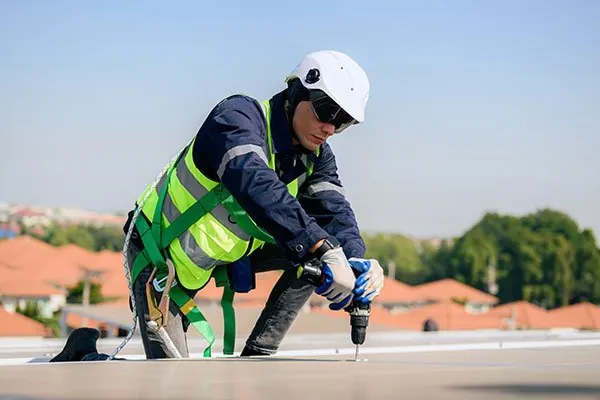
- If the job involves anything beyond reaching from a ladder, use a roofer with fall protection.
Older homes may have asbestos cement in eaves linings or roofs. Do not drill, cut or pressure-wash it. Once a removal job goes past 10 square metres of bonded (non-friable) asbestos, WorkSafe Victoria requires a licensed removalist to do it.
Have a plan beyond the roof
A well-prepared roof improves a home's chances, but no preparation makes a house safe to shelter in on the worst days. Write your bushfire plan, decide your trigger to leave early, and check fire danger ratings through official channels each day during summer. The CFA and VicEmergency provide warnings and planning tools.
Getting the roof sorted
If your inspection turns up broken tiles, failing ridge capping, open gaps or tired gutters, it is better to fix them before summer than during it. Roof Repair Melbourne VIC can connect you with independent local roofers for a free quote at the property, and you can ask about their experience with bushfire construction rules while they are there. Check their roof plumbing registration and insurance before agreeing to work. Book through our contact page.